Showing posts with label ohm's law. Show all posts
Showing posts with label ohm's law. Show all posts

Wednesday, May 4, 2011
ELECTRIC CIRCUITS
Just as water flows in a pipe from a higher level (or higher pressure) to a lower level, so do the electrons in a conductor. They flow from a point of higher potential to a point of lower potential. The path followed by the electrons is called the electric circuit.

If a material having free electron (such as copper, silver, etc.) as connected between the terminals of a battery, having an e.m.f. the electrons in the material being negatively charged, are continuously attracted to the positive terminal of the battery and repelled by the negative terminal. The flow of electrons, (as mentioned earlier) will constitute an electric current.
Although the drift of the electrons in the material is towards the positive terminal of the battery, the direction of the current is taken as opposite to the electron movement. This direction of current has universal acceptance and is known as the conventional current, whereas the term "electronic current" is used by those who depart from this convention. The people consider electron movement and current direction to be the same.

Above diagram shows an Electric Circuit. This is a closed circuit. But if a switch is introduced in one of the connecting wires between connections are more complex, a circuit may have open circuit part as well as a closed circuit part; then the whole arrangement is called either circuit or a network.
SPECIFIC RESISTANCE OR RESISTIVITY
The Specific Resistance or Resistivity of a material depends upon the nature and composition of the material.


From the relation ,

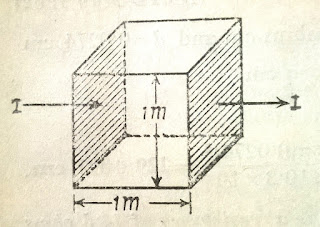
if l = 1 m and A = 1 sq m
then R = 𝜌.
Hence, the specific resistance of a conductor may be defined as the resistance offered by unit m cube of the material of the conductor.

It can also be defined as the resistance of a conductor of 1 m length and 1 sq m cross-sectional area.

The unit of resistance is ohm-m or ohm per m³.
If the unit of length is in cm, then the unit of resistivity is ohm-cm or ohm-cm³.
RESISTANCE AND UNIT OF RESISTANCE - OHM
Resistance: "The flow of electrons through a conductor is opposed by the conductor. Since this flow of electrons constitutes a current, the flow of a current is offered opposition by the conductor. This property of the conductor due to which it opposes or resists the flow of electrons is called Resistance."
A device whose chief property is to oppose or resist is called Resistor. And If the opposition is variable, the device is called a variable resistance or a Rheostat.
The unit of Resistance is ohm (𝛺) and it is pronounced as omega.
A conductor is said to offer a resistance of 1 ohm, when it allows a current of 1 ampere to flow through it when 1 volt of potential is applied across its terminals.
When the resistances are too high (e.g., for insulators) to be measured in ohms, one may employ the unit kilo-ohms (K𝛺) or mega-ohms (M𝛺). If the resistances are very small (less than an ohm), units such as milli ohm (10⁻³ 𝛺) or micro-ohm (10⁻⁶ 𝛺) are used.
In an electrical formula, the letter "R" generally stands for the resistance of a conductor.
A device whose chief property is to oppose or resist is called Resistor. And If the opposition is variable, the device is called a variable resistance or a Rheostat.
The unit of Resistance is ohm (𝛺) and it is pronounced as omega.
A conductor is said to offer a resistance of 1 ohm, when it allows a current of 1 ampere to flow through it when 1 volt of potential is applied across its terminals.
When the resistances are too high (e.g., for insulators) to be measured in ohms, one may employ the unit kilo-ohms (K𝛺) or mega-ohms (M𝛺). If the resistances are very small (less than an ohm), units such as milli ohm (10⁻³ 𝛺) or micro-ohm (10⁻⁶ 𝛺) are used.
In an electrical formula, the letter "R" generally stands for the resistance of a conductor.
ELECTRIC FIELD
Electric Field: If electric charges in a space experiences force, the space contains an electric field and if these forces move the charges from one point to another, work is said to be done on them.
Monday, May 2, 2011
ELECTROMOTIVE FORCE (E.M.F.)
Electromotive Force: Electromotive Force (emf) is the force which creates the pressure that causes the current to flow through a conductor.
Its unit is a volt and is defined as the emf necessary to cause one ampere of current to flow through a resistance of one ohm
Electric Pressure is also called voltage or potential. Where the unit of volt is too large, we may use the milli-volt (mV) which is one thousandth (1/1000) of a volt or the micro-volt (𝜇V) which is (1/1000000) of a volt. Sometimes it is more conventional to use very high voltage unit, called as kilo-volt (kV), which is equal to 1000 volts.
Voltage or potential difference between two points is denoted by V.
ELECTRIC CURRENT
The amount of positive charge equals the amount of negative charge and therefore an atom always behaves neutrally.
If an electron is removed from a neutral atom, this atom becomes positively charged and is called a Positive ion. On the other hand, if an electron is added to a neutral atom, it becomes negatively charged and is called a Negative ion. Thus atoms which have lost or gained one or more electrons are called Ions.
Between any two ions, there exists a stress or field of force. Similarly charged ions repel whereas disimilarly charged ions tend to attract each other. Generally, this field of force is called the electric, dielectric or electrostatic field.
The movement of ions arising from the presence of this field is called the Electric Current.
OHM'S LAW
Ohm's Law: This law gives the relation between the potential difference V and the current I flowing through a conductor.

It may be stated as:
"For a given conductor the ratio of the steady direct potential difference V between its ends to the steady direct electric current I flowing through the conductor, is a constant, provided the physical conditions of the conductor , for example- temperature, etc., remain unchanged."
This Law, however, is also applicable to AC circuits.
It can be represented by

or 

or 

or 

or 

where R is a constant for the conductor and is called its electrical resistance or resistance of the conductor
The quantities V, I and R measured in volts, amperes, and ohms respectively.
From the above relation of Ohm's law i.e., V = I R , it may be deduced that a conductor is said to offer a resistance of one ohm, when a unit potential difference (1 volt) applied across its ends, causes a unit current (1 ampere) to flow through it.
Subscribe to:
Posts (Atom)